Maundy Thursday 2026
The Pattern of Love: Homily by Abbot Brendan
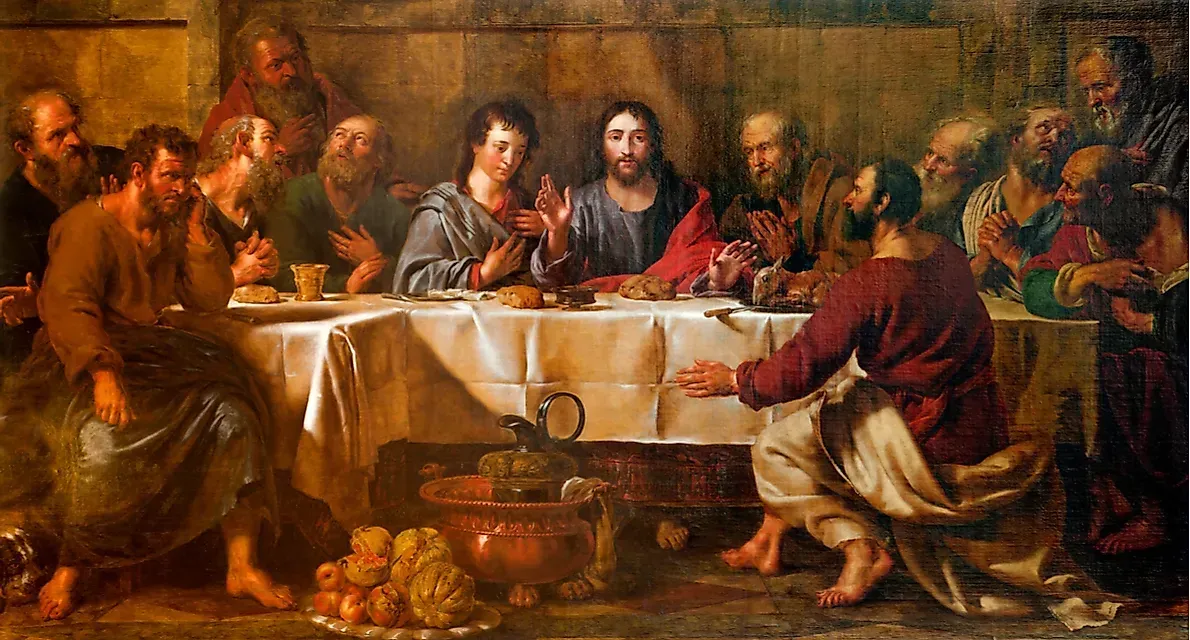
His hour had come. When the dark forces of the world were closing in, before he was betrayed by a kiss, Jesus gathered with his disciples in an upper room in Jerusalem. He took bread, blessed and broke it, and gave it to them. He took the cup and said: “This is my Body… this is my Blood, given and poured out for you.”
And for two thousand years, in great cathedrals and in the simplest chapels, the Church has been faithful to his command: to take and eat, to take and drink.
But St John the Evangelist gives us something striking. He does not describe the bread and the cup. Instead, he shows us Jesus kneeling on the floor, washing the disciples’ feet.
As if to say: this is what it means.
“Having loved his own who were in the world, he loved them to the end.”
The Eucharist and the washing of the feet are not two things. They are one. One mystery, one movement: a love that gives itself completely.
Tonight’s Eucharist is celebrated in the shadow of betrayal and death. It cannot be separated from what is about to happen. What Jesus does in sign at the table, he will do in reality on the Cross.
And so we begin to see the pattern.
He takes.
He blesses.
He breaks.
He gives.
This is what happens to the bread.
It is also what happens to him.
Taken by men.
Blessed in obedience.
Broken on the Cross.
Given for the life of the world.
And this, quietly, is what is meant to happen to us.
“Do this,” he says.
Not only at the altar.
But with your life.
My life received as gift.
Lived in gratitude.
broken open
and shared with others.
This is the shape of love.
And this is where what we call “communion” finds its meaning—not as a separate idea, but as the fruit of this self-giving. Because when lives are given like this, something happens: we become one.
“Receive who you are and be who you receive” says St Augustine.
Receive the Body of Christ, and be the Body of Christ.
As Saint Paul says, “Because there is one bread, we who are many are one body.”
Not because we agree.
Not because we always understand one another.
But because we are drawn into the same self-giving love.
The one next to you, the one you struggle with, the one you do not understand—they too are part of this Body. And so, on this night, the Church sings:
Ubi caritas et amor, Deus ibi est—
where charity and love are, God is there.
Not in the abstract.
But here.
In this community.
In these relationships.
So tonight we come to the altar. We receive the Body of Christ. But the question is this: will we recognise that same Body in one another? Will we allow our lives to take that same shape—to be taken, blessed, broken, and given?
Because the love Christ commands is not extraordinary in appearance.
It is as ordinary as bread, as daily as wine.
And yet, lived in him, it becomes divine.
“This is my commandment: love one another.”
Not as an idea, not as a feeling, but as a way of life:
a life poured out, a life shared, a life given—for the other.
This is the pattern of love laid down by Jesus for the life of the world.