Never lose hope in God's mercy
On the Commemoration of All Souls, Abbot Brendan reflects on the experience of death within a monastic community, the meaning of Purgatory, and St Benedict’s invitation never to lose hope in the mercy of God.
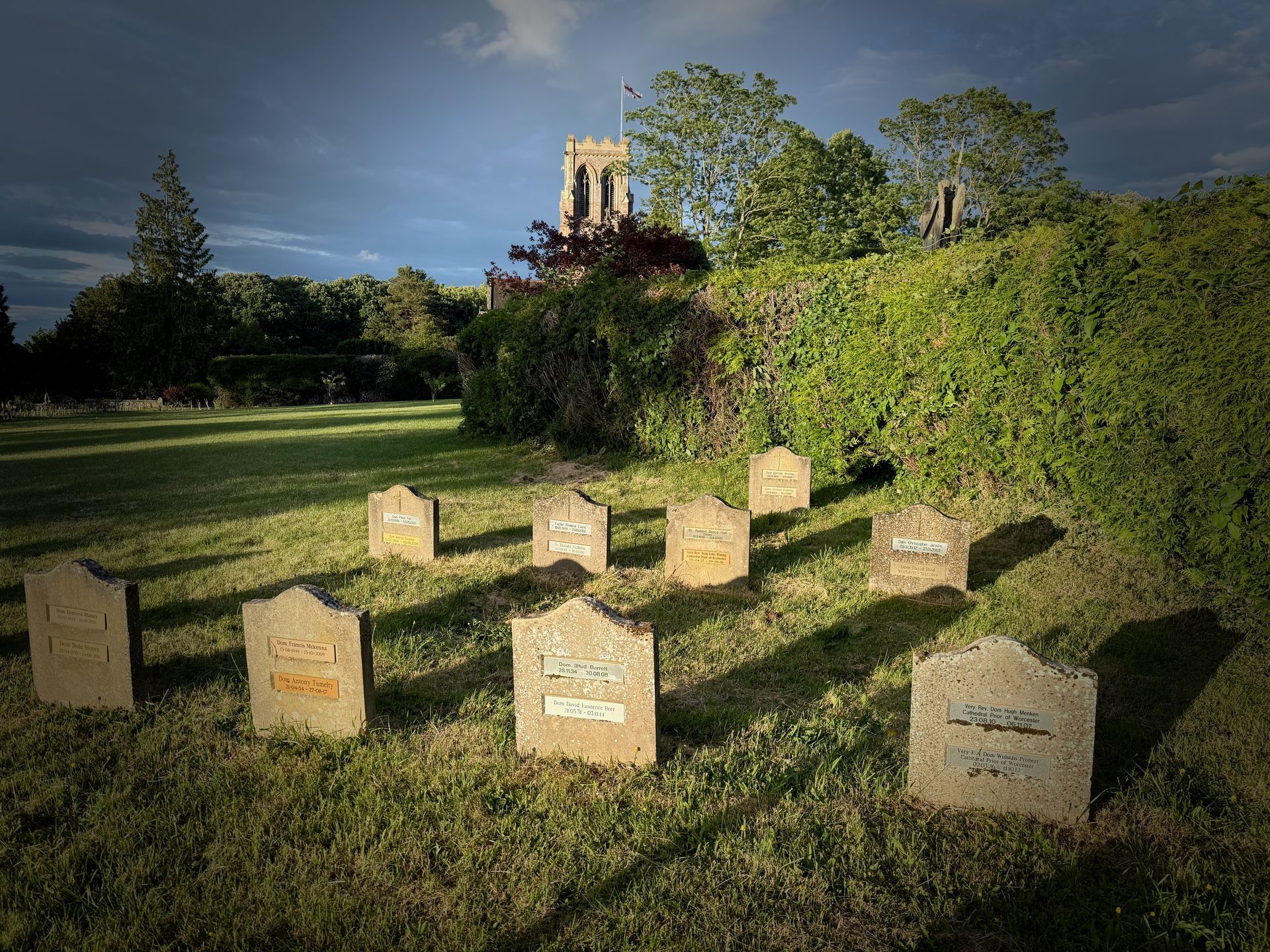

One of the rather unusual things about living in a monastery is that we regularly bury our dead. In modern society death has sometimes become something rather remote, that happens behind hospital doors or is managed by professionals. Increasingly, some people choose a direct cremation or burial, without a traditional funeral. There may be good reasons for this, but something important can be lost when we no longer gather to mourn those we love and commend them to God.
But in a monastery death is part of the life of the community. We have all prayed beside the body of one of our brethren, celebrated his funeral, sung the Suscipe over him, and carried him to the cemetery to lay him in the ground. The Suscipe is the prayer we sing when we make our monastic profession, offering our lives to God: “Receive me, Lord, according to your word, and I shall live.” What we prayed when we first offered our lives to God becomes our prayer when that offering is complete.
And then we have returned to the monastery, to the familiar rhythm of prayer and work, knowing that one day it will be our turn. There is something wonderfully honest about this. A monastery is a place where we learn how to live, but it is also a place where we learn how to die.
St Benedict tells us to keep death daily before our eyes (RB 4:47). Not because he wants us to be morbid, but because he wants us to live truthfully. Death puts things into perspective. So many of the things that preoccupy us, our little disagreements, our disappointments, our anxieties, our ambitions, suddenly seem rather less important when we stand beside the grave of a brother.
When we bury one of our brethren, we are burying someone whose life has become woven into our own. We have prayed together, eaten together, worked together, sometimes irritated one another, perhaps even struggled to understand one another. We have known something of his virtues and his failings, just as he has known ours. And the time comes to commend him to God. We do not have to pretend that he was perfect. We do not need to. We simply entrust him to the mercy of God.
And when we pray for our departed brethren, we continue to care for one another even beyond death. The brother who is no longer sitting in his stall in choir is not forgotten. His name is remembered, prayers are raised, Masses offered. And the communion we shared in this life is not simply extinguished by death. We remain members of the one Body of Christ.
All Souls reminds us that our community is larger than those of us who happen to be living here at present. We belong to a great procession of monks who have gone before us, prayed with us, walked beside us, struggled with the same human weaknesses and sought the same God. They have handed something on to us, and we shall hand it on to others. Our monastery is a communion stretching across generations, and death does not destroy that communion.
What happens when we die?
But what happens when we die? What are we praying for when we pray for our departed brethren?
I have found Pope Benedict’s reflections on purgatory in Spe Salvi particularly beautiful. He draws on the suggestion that the purifying fire of which Scripture speaks is Christ himself. Purgatory is understood as an encounter with Christ, whose love burns away everything in us that is false, everything that prevents us from being fully ourselves and fully God’s. (Benedict XVI, Spe Salvi, 47)
He writes: “Before his gaze all falsehood melts away.” That is a remarkable thought. We spend so much of our lives hiding things, even from ourselves. We construct little defences, make excuses, justify our behaviour, cling to resentments, protect our pride. Even after many years in the monastery, we are not necessarily free of these things. We may have made solemn profession, but that does not mean that the work of conversion is anywhere near over.
And yet we hope that when we finally stand before Christ, all these things will fall away. We shall see ourselves as we truly are, but we shall see ourselves in the light of his love. There will be nothing to hide, nothing to defend, nothing to pretend.
And perhaps that is what purgatory really means: the final work of conversion, when the love of Christ completes what his grace has begun in us.
The Final Transformation
One of the vows we make as Benedictine monks is conversatio morum, a commitment to the monastic way of life. But it is much more than simply remaining faithful to a particular way of living, a static form of fidelity. It is a commitment to lifelong conversion, in which we open ourselves to the transforming work of the Holy Spirit. We do not enter the monastery because we are holy. We enter so that this life may shape us, open us to God’s grace, so that we may become holy, and this means recognising what within us needs to change. And we discover, sometimes rather painfully, that this conversion is the work of a lifetime.
Perhaps we might say that purgatory is the completion of our monastic conversion. The final surrender of all those things that we have spent a lifetime struggling to surrender. And what is true of the monk is surely true of every Christian life, for all of us are called to be transformed by the grace of God. The moment when we can at last allow ourselves to be loved without resistance, entrusting ourselves entirely to the God who has loved us all along.
In his final words of Chapter 4 of his Rule, on the Tools of Good Works, Benedict ends with that memorable injunction: “Never despair of God’s mercy.”
After all the demands of the Christian life, after the struggle against sin, after the call to humility, obedience, charity and self-denial, Benedict leaves us with mercy. It is as though he knows that, at the end of the day, this is what we shall need most.
And perhaps it is what we need most at the end of our lives. We shall not arrive before God with a perfect record of monastic observance. We shall not be able to present him with an unblemished history of charity, patience and humility. We shall come as we are, with all the unfinished business of our lives. But we shall come before the One who has loved us from the beginning, who called us into this life, who has sustained us through all its difficulties, and who will not abandon us at the end.
There is a lovely line in George Herbert’s poem Love: “Love bade me welcome; yet my soul drew back, Guilty of dust and sin.” Perhaps that is how we shall feel when we first stand before God. But the whole movement of the poem is towards the discovery that we are welcome, not because we deserve to be there, but because Love himself has invited us.
So today, as we remember our departed brethren, we pray for them with affection and gratitude. We pray that whatever remained unfinished in their lives may now be completed in the love of Christ. We pray that they may be freed from everything that prevented them from loving God with their whole heart.
And we pray for ourselves too. That we may learn to live with death before our eyes, not with fear, but with hope. That we may grow a little more patient with one another, a little more forgiving, a little less concerned with the things that ultimately do not matter.
One day another generation of monks will pray for us. They will stand beside our graves and commend us to God. They will know, as we know, that we were not perfect. But they will pray that the mercy of God may bring to completion the work he began in us.
And perhaps, when our own life draws to its close, we shall discover that the most important thing St Benedict ever taught us was also the last of his instruments of good works: Never despair of God’s mercy.
Prayer for the Deceased of Our Monastic Community
O God of mercy and compassion,
we give you thanks for our brethren
who have walked before us in this monastic way of life.
Receive them now into the light and peace of your kingdom.
Forgive their sins, heal their wounds,
and bring to perfection the good work
you began in them.
May they rest from their labours
and rejoice in the company of the Blessed Virgin Mary,
our holy Father Benedict, St Michael, St Gregory, and all the saints,
until we too are gathered into your presence,
where love is brought to its fullness
and every longing finds its rest.
Through Christ our Lord. Amen.