Assumption 2026
Nothing that is precious and dear to God is simply discarded: homily by Abbot Brendan.
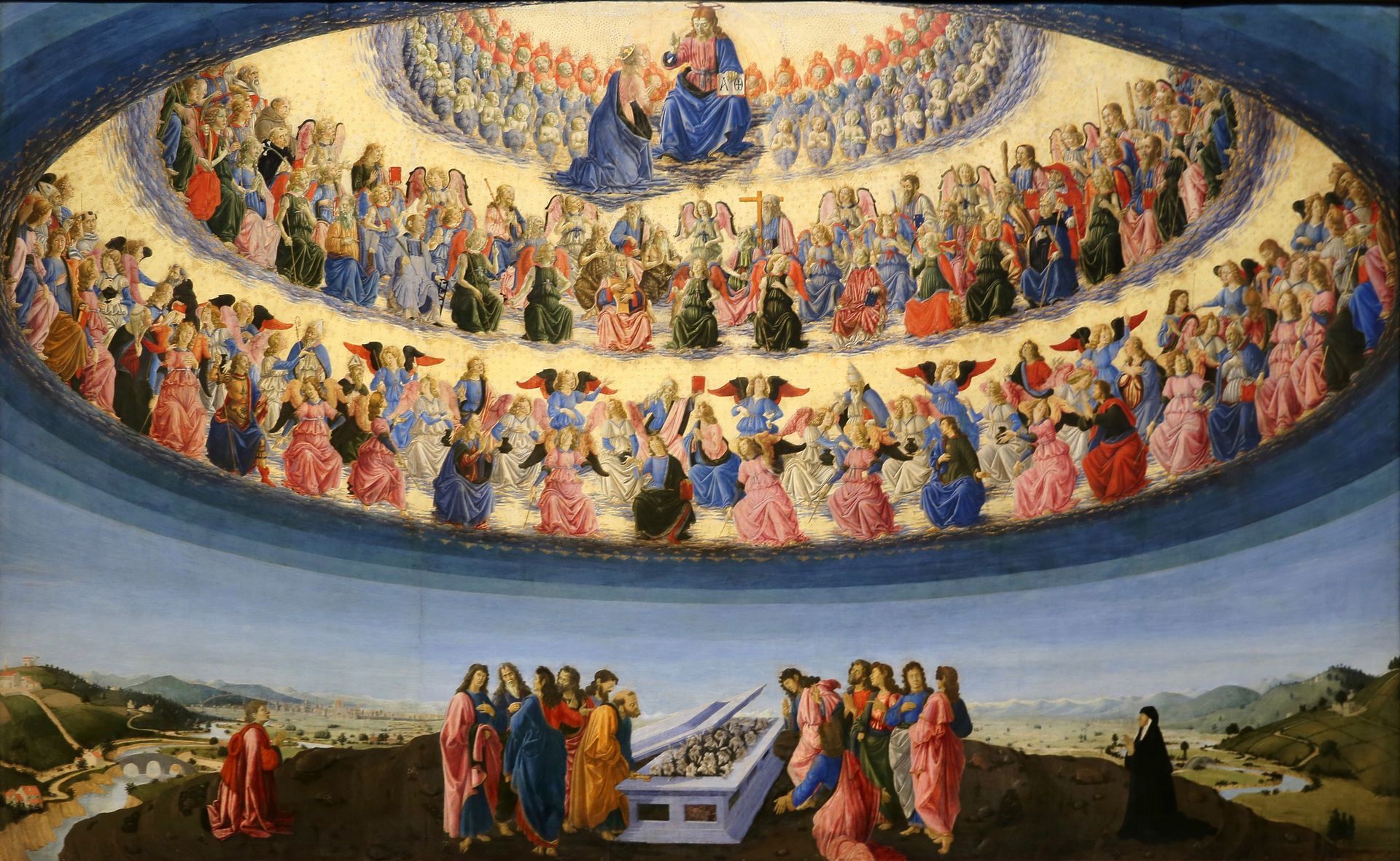

For many years, if you ascended the stairs of the Sainsbury Wing of the National Gallery, you would see this wonderful painting of the Assumption of the Virgin by Francesco Botticini. Mary is in heaven crowned by her Son, surrounded by ranks of angels and saints beneath a great golden dome. And down on earth are the apostles, bemused, gazing into an empty tomb. But not quite empty. Her mortal remains, in the imagination of the artist, have been replaced by pure white lilies.
We might borrow the words of the angel at the Ascension of Jesus: “Men of Galilee, why do you stand looking into heaven?” How many people climbing those stairs must have looked into Botticini’s heaven and wondered: what is this scene about?
The Catechism tells us that, when the course of her earthly life was finished, Mary was taken up body and soul into heavenly glory. But it immediately adds something of great importance: this is “a singular participation in her Son’s Resurrection and an anticipation of the resurrection of other Christians.”
So today is a feast of Easter: Easter in August; Mary’s Easter, and the promise of ours. The Preface of today’s Mass calls her “the beginning and image of your Church’s coming to perfection, and a sign of sure hope and comfort to your pilgrim people.” Mary is not simply an exception, taken out of the human story and placed far above it. She is its beginning and image. In her we see where the whole human story is intended to go.
Although this feast calls us to lift our minds and hearts to things above, its most profound message is how we should understand our human existence here below.
The Assumption is the crowning of Mary’s dignity: not because she had escaped her humanity, but because her humanity—body and soul—has been caught up into the life of God. This is such an earthly feast. It speaks of the final destiny of flesh and blood; of the value of this created world; of all that God has made and loves.
Christianity does not offer an escape from the world, nor a vague survival of the soul after everything that has mattered – matter - has fallen away. We profess “the resurrection of the body and the life of the world to come.”
This is not a question of space flight, as though we were being asked to imagine where heaven might be, or how a body might travel there. The reality is deeper and more mysterious than that: something no mind or imagination can fully capture. But we know that nothing is impossible to God. The One who called us into being still loves us, will love us to the end, and will pursue us through the years to our ultimate destiny. That is the essence of this feast.
Nothing that is precious and dear to God is simply discarded.
In the Gospel, Mary sings her Magnificat. God has looked upon a young woman of no social importance, living in an obscure village at the edge of an empire. And now all generations call her blessed. God sees the one whom the world overlooks. He raises the lowly. He fills the hungry with good things.
Pope Leo, in his recent Encyclical Magnifica Humanitas, reminds us that human dignity does not depend upon ability, wealth, status or usefulness. It is not something we earn. Nor can it be taken away by failure, humiliation, illness or exclusion. We have dignity because we are willed, created and loved by God.
Mary’s Assumption is the great and radiant confirmation of that truth. God does not merely save an idea of Mary, nor preserve a disembodied soul somewhere in heaven. He receives the whole person whom he created, redeemed and loved. In her Assumption, heaven says “yes” to the human person.
And therefore it says “yes” to the old person who feels that life has passed them by; to the person whose body is frail or failing; to the one who feels unseen, unproductive or unwanted; to those whose dignity is daily denied by poverty, violence, war or neglect.
The final word over any human life is not death or decay. The final word is the love.
St Paul tells us that creation itself “will be set free from its bondage to decay and obtain the glorious liberty of the children of God.” Every hair of our head is counted. The world to come is not the abolition of all that is good in this world, but its fulfilment.
As Pope Leo beautifully puts it, “In this plan nothing will be lost that is authentically human. Indeed, everything will be purified and gathered into the One who gathers every fragment of life, every tear, every authentically human achievement, rescuing them from nothingness and delivering them, redeemed, to the Father.”
Today Mary stands before us as that promise made visible. So let us look to heaven—but not in order to turn away from the earth. Let us look to heaven so that we may learn, here and now, to reverence the dignity of every human person, and to live as people whose destiny is glory.